



Dubai Without Data Is a Disaster Waiting to Happen
You land in Dubai.
The skyline hits first, then the heat, then the eerie quiet from your phone.
No Uber, no Google Maps, no way to reach your hotel, and you're just standing in arrivals looking completely lost.
I've been there. Not Dubai specifically, but I've had that exact moment in three different countries where my SIM refused to cooperate and the trip went sideways before it even started. The fix isn't complicated. One decision, made before you board, changes everything. Travel eSIMs exist precisely for this situation, and Indian travellers are still massively underusing them. These five tips cover device checks, data sizing, and cost savings, so you land ready rather than scrambling.
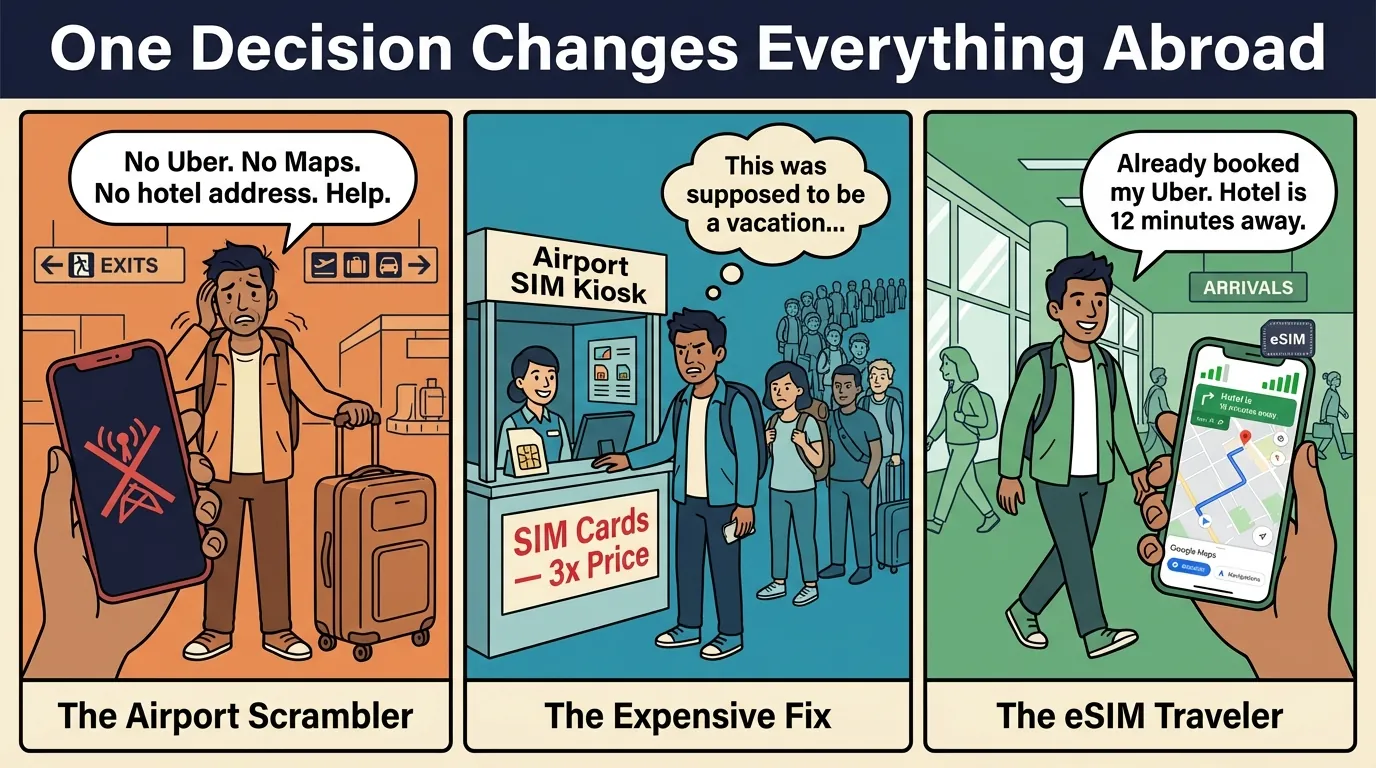
Sort your Dubai eSIM before departure. That single call separates a smooth trip from a stressful one.
"No matter why you're going to Dubai or how long you'll stay there, travel eSIM is something you just cannot ignore. It's that one travel essential that can make or break your trip."
Tip #1: Buy Your Dubai eSIM Before You Board the Plane
Buy your Dubai eSIM before you leave India. Not at the airport. Not on arrival.
The Dubai eSIM before you fly decision is the single most consequential one you'll make for staying connected. Most travellers get this wrong because they assume the airport will sort them out, and then it doesn't. The airport option exists, yes, but it costs more, takes longer, and puts you on the back foot before your trip even begins. Your eSIM should be purchased, downloaded, and sitting dormant on your phone before you board. The moment your plane touches down in Dubai, you're already online. No queues, no haggling, no roaming shocks.
Buy early. Install early. Arrive connected.
For Indian travellers, services like Matrix let you order a Dubai eSIM before departure with instant QR code delivery, no airport queues, no roaming surprises. You get the QR code by email, scan it at home, and the profile sits quietly on your phone until you activate it in Dubai. That's the whole process. Minutes, not hours.
The pre-departure purchase also gives you time to troubleshoot. If something doesn't scan correctly, you want to fix it on your couch in India, not at Dubai International at midnight. Confirm the QR code works, check the profile installed cleanly, then forget about it until you land.
Buy before you fly. Simple.
Check the Dubai eSIM activation rules before you commit to a provider, because Dubai has a specific requirement many travelers miss entirely. Unlike most destinations where eSIM activation is fully self-service, certain Dubai eSIM providers require KYC verification at government-authorised partner stores. Those stores are at airports and scattered across the city, so it's manageable. Knowing this before you land means no unpleasant surprises when you arrive.
Plan for it.
Some providers handle KYC digitally and some don't. Read the activation instructions for your specific plan before departure. That two-minute read prevents real confusion on arrival day.
Why Airport SIM Queues Are a Trap You Can Easily Avoid
The airport SIM queue is a trap. You're exhausted, jet-lagged, hauling luggage. Kiosk prices run inflated and the wait is genuine. Meanwhile, someone who bought their Dubai eSIM last week has already cleared customs and is halfway to their hotel. The gap between those two experiences comes down to one purchase made at home. Alike currently offers a complimentary 5G eSIM with 1GB data as a trial option for new users, though you should confirm current availability directly. Pre-booking perks like that simply don't exist at airport kiosks.
The Install Now Activate Later Method That Frequent Travelers Use
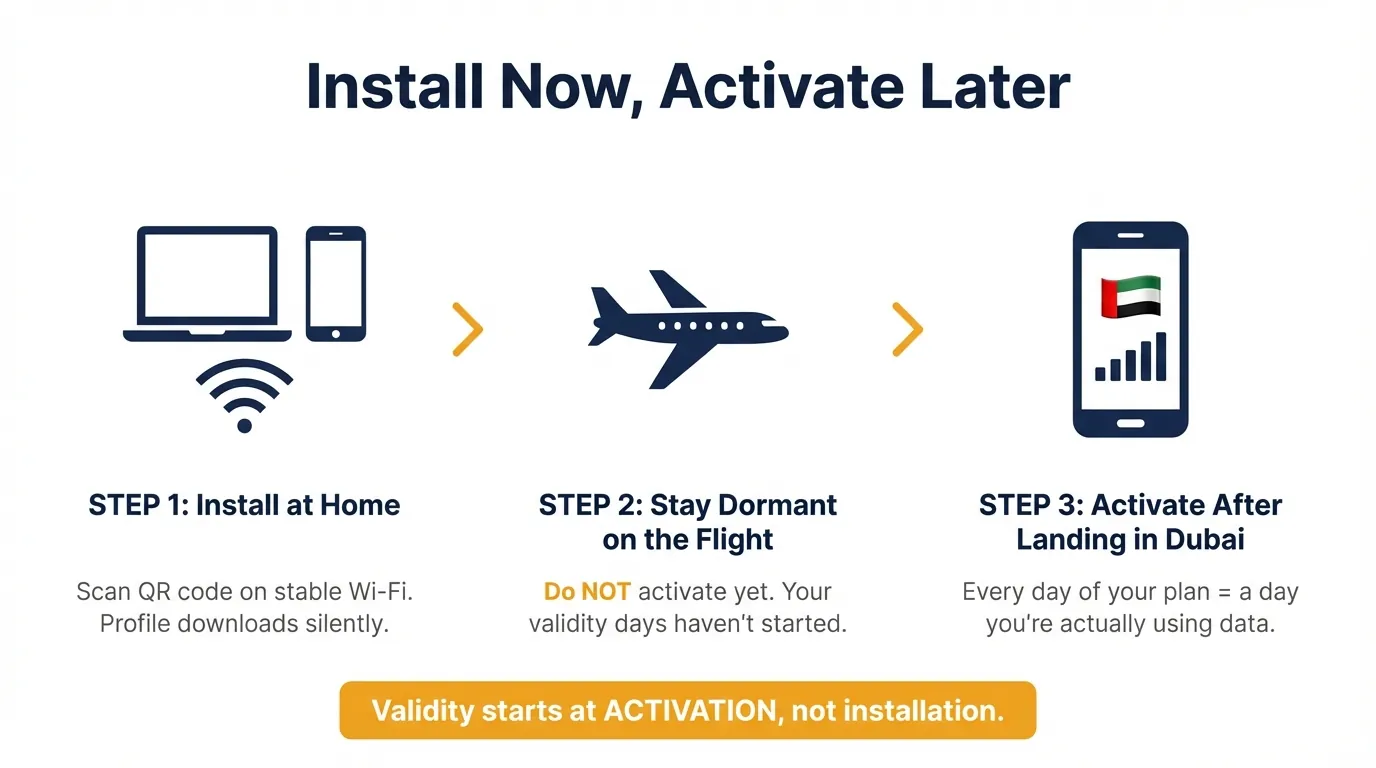
Install the eSIM profile at home on stable Wi-Fi. Keep it dormant through the flight. Activate only after landing in Dubai. This is the sequence frequent travelers follow instinctively, and it matters for one very specific reason. Your validity days start counting from activation, not from installation. Installing at home and activating in Dubai means every day of your plan is a day you're actually on the ground using data. Don't activate early and burn days sitting on a plane.
Tip #2: Check Your Phone Is Enabled and eSIM Compatible Before Anything Else
Do this check now, not the night before your flight.
Your phone has to clear two hurdles before a Dubai eSIM will work on it. First, your home carrier must have it enabled. Second, eSIM hardware needs to be physically built in. Miss either one and the eSIM simply won't function. Full stop. Most current flagship phones from Apple, Samsung, and Google carry eSIM support. But phones purchased on a carrier contract may still be locked even when they're eSIM-capable. These are two completely separate issues, and both require confirmation.
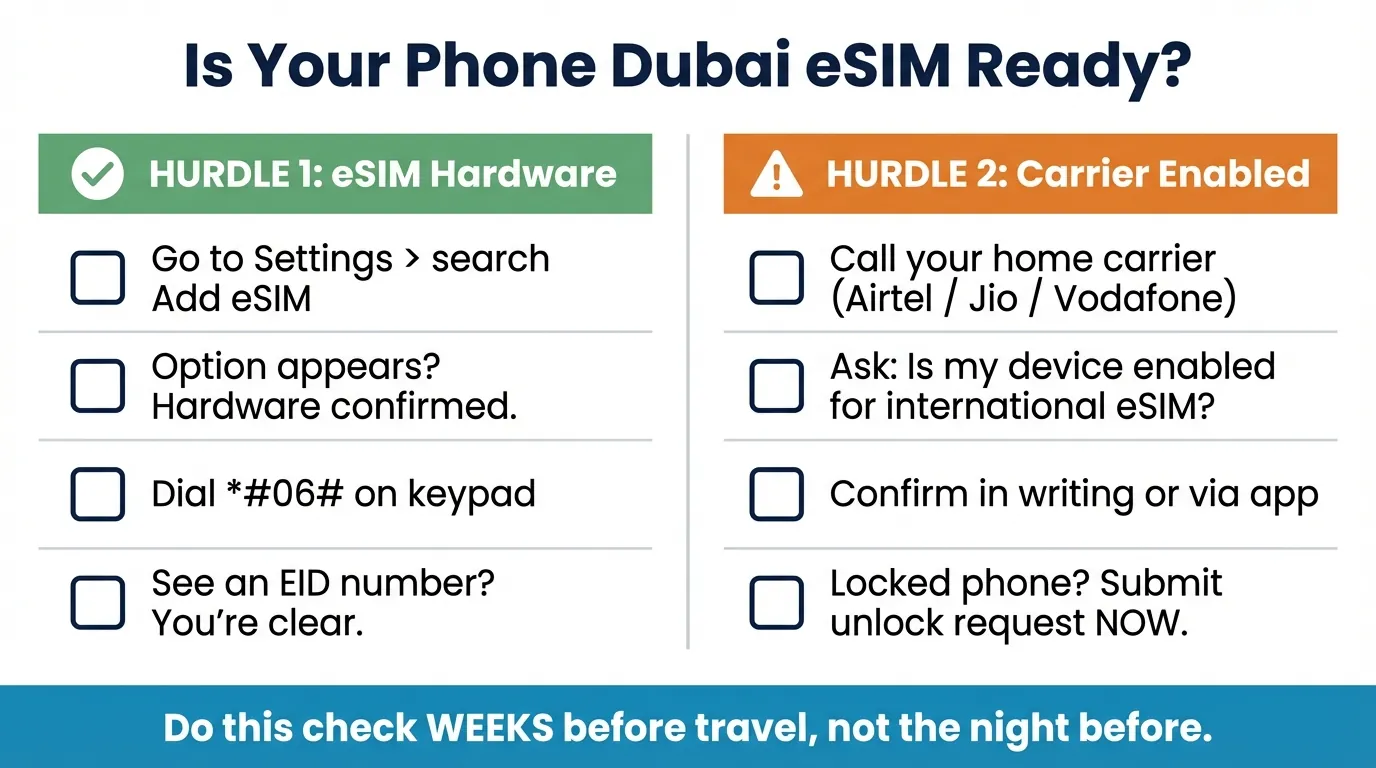
Open your phone settings right now and search for "Add eSIM" or "Add Data Plan." If that option shows up, your phone has the hardware. Dial \#06# from your keypad and check the results for an EID number. An EID confirms eSIM support at the chip level. Spot one, and you're clear on the hardware side. Then check whether your phone is actually enabled, because hardware alone won't get you there.
Call your home carrier or pull up their app. Ask them directly whether your device is enabled for international use. Five minutes, maybe less.
Do it weeks before travel, not days.
The Two-Minute Phone Check That Saves You a Massive Headache
Settings, then search "Add eSIM." That's step one. If the option appears, your phone supports eSIM. Then dial \#06# and look for an EID in the display. No EID means no eSIM support, regardless of what the spec sheet says. If you bought your phone on a plan, contact your home carrier to confirm it's enabled. The whole process takes two minutes and should happen well before your departure date.
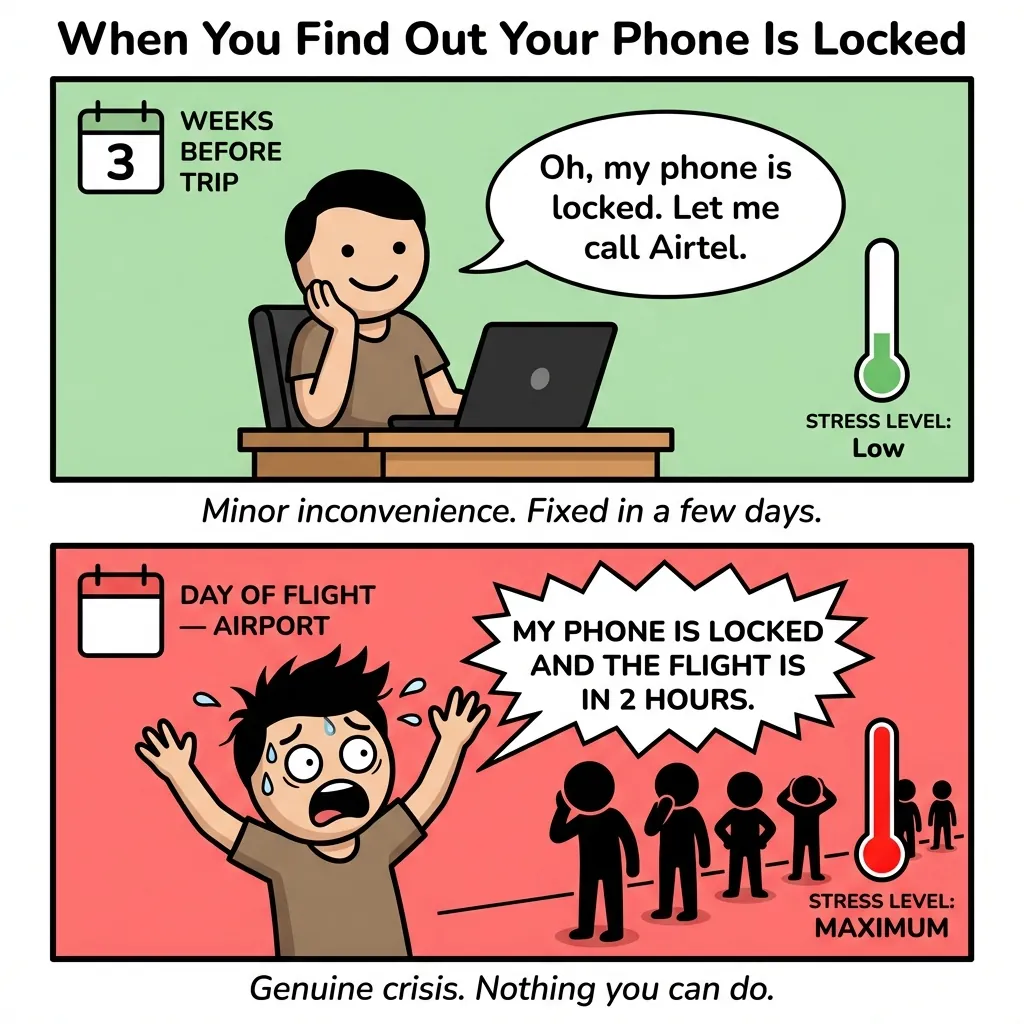
Finding a locked phone issue three weeks out is a minor inconvenience. Finding it at the airport is a genuine crisis.
What Happens If Your Phone Is Locked and How to Fix It Fast
Submit an enable request to your home carrier the moment you confirm the problem. Airtel, Jio, and Vodafone all have processes for this, though processing times differ. Budget several business days at minimum, which is exactly why an early check matters so much. If your phone is older or a budget Android model, check the spec sheet specifically for eSIM support. Some devices simply don't have the hardware built in. A physical international SIM card is the practical fallback in that situation, and planning for it beats hoping things work out on their own.
Tip #3: Use Dual SIM Mode So Your Home Number Never Goes Dark
Dual SIM travel is the smartest move experienced travelers make. Most people don't even know it's an option.
Your Indian SIM stays in your phone the entire trip. Your Dubai eSIM carries all the data. Your family still reaches you on your regular number. WhatsApp keeps running on the number everyone already has saved. You don't send a "new number for Dubai" message to fifty contacts. Frequent travelers operate this way because most modern smartphones support one physical SIM and one eSIM running at the same time.
That setup changes everything.
The home SIM stays active for incoming calls and messages on your familiar Indian number. The Dubai eSIM takes over as the default data connection. Costs don't double because the home SIM isn't pulling data abroad, just receiving calls. That distinction separates dual SIM done right from dual SIM done expensively.
One settings change makes this work. Go into your cellular or mobile data settings. Set the Dubai eSIM as the default data line. Leave the home SIM active, but turn off data roaming on that line specifically. This blocks accidental data charges on your Indian plan while you're abroad. Your home carrier can't bill you roaming data fees if data roaming is switched off on that line.
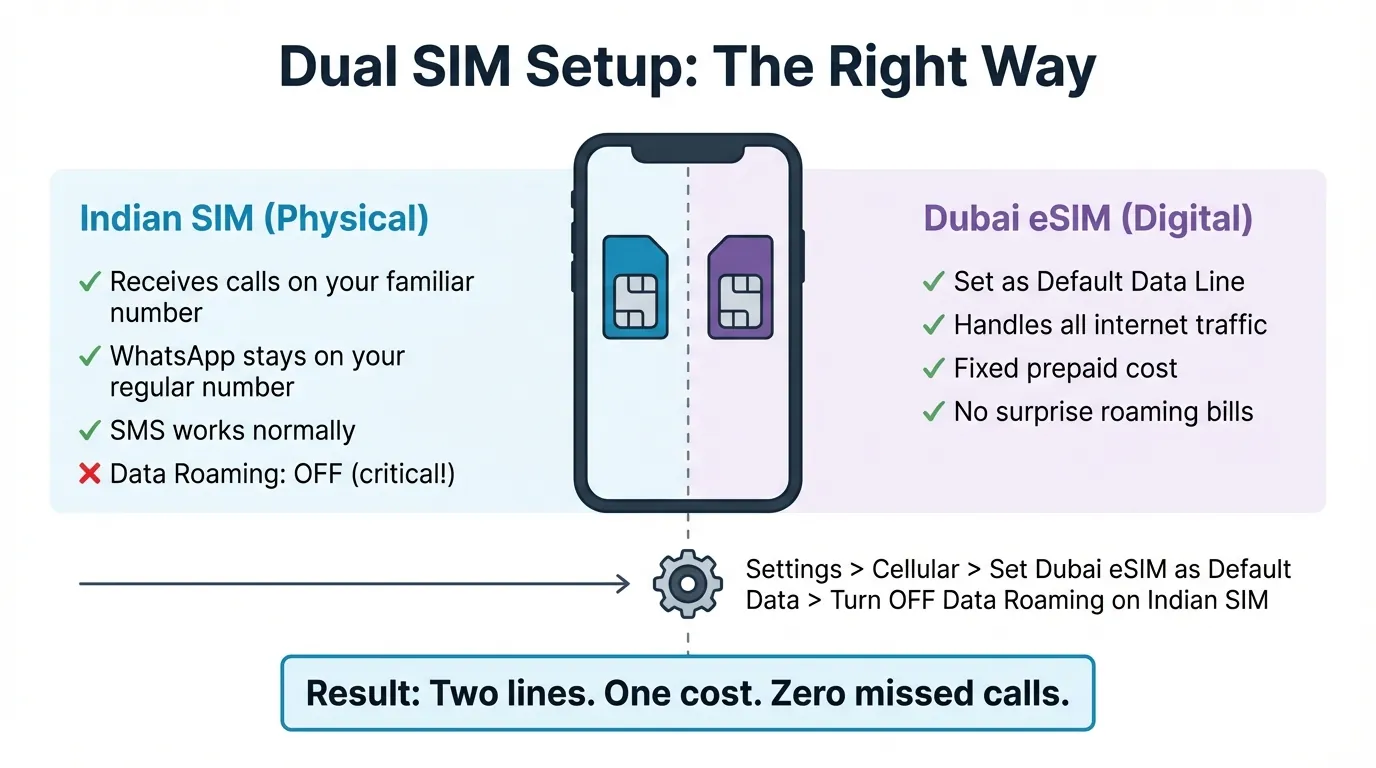
Calls still come through on your Indian number. SMS still works. WhatsApp runs on data through the Dubai eSIM. You've built a two-line system that costs a fraction of full roaming.
Try this before leaving India. Configure the dual SIM setup at home so you know it's working correctly before you're standing on a Dubai street actually needing it.
Why Smart Travelers Never Turn Off Their Home SIM Abroad
Modern smartphones handle physical SIM and eSIM simultaneously without any trouble. Your home SIM sits in the tray doing its job, receiving calls and SMS on your familiar number. The Dubai eSIM runs quietly as the data engine. Nobody needs a new number. Nobody misses a call. Set the Dubai eSIM as the default data line in settings and the phone handles the rest.
The One Settings Change That Makes Dual SIM Work Perfectly
Open cellular settings and assign the Dubai eSIM as your default data connection. Then go into your home SIM settings specifically and switch off data roaming on that line. This is the nuance most beginners miss. Data roaming off on the home SIM means no accidental charges from your Indian carrier. Calls and SMS still work on that line without roaming data fees. Your home SIM receives calls. Your Dubai eSIM moves data. Clean, cost-effective, and straightforward once you've done it once.
Tip #4: Pick the Right Data Plan Size for How You Actually Travel in Dubai
Plan size is where most travelers get it wrong. They buy too little and panic halfway through the trip, or they overbuy and throw money away on gigabytes they never touch.
Don't guess.
- Light users (maps, ride apps, messaging) - 3 to 5GB for a week
- Moderate users (browsing, photo sharing, short videos) - 10 to 20GB for a week
- Heavy users (video calls, streaming, remote work) - 30GB or more
Travel days tend to push usage well above your normal baseline. Navigation runs constantly. Photos get uploaded faster than usual. Translation apps open and close all day long. Factor that in when you're sizing up your plan.
Go bigger rather than smaller. Running out of data in Dubai is frustrating, and fixing it mid-trip costs more than just buying enough upfront.
The Three Traveler Types and How Much Data Each One Actually Needs
Light users stick to maps, messaging, and ride apps. A week on 3 to 5GB works for this profile. Moderate users sharing photos and browsing regularly need 10 to 20GB for a comfortable week. Heavy users on video calls or remote work sessions should plan for 30GB minimum. MobiMatter flags these as estimates, and most travelers underestimate how much they burn through on travel days specifically. Navigation alone can eat through data faster than you'd expect when you're in an unfamiliar city and checking your route every few minutes.
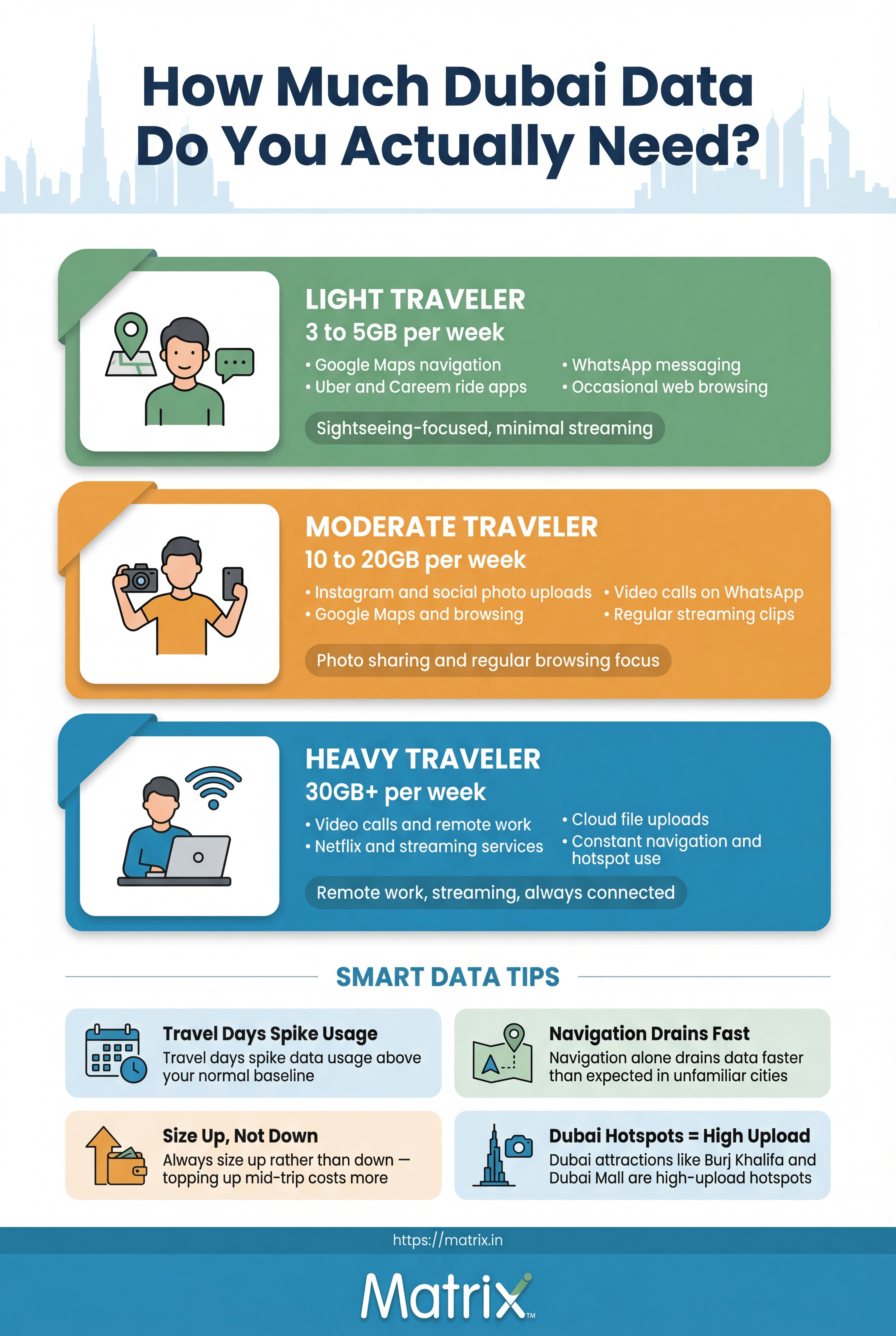
Treat this as your planning anchor, not a hard ceiling.
Why Dubai Attractions Are Data Black Holes You Need to Plan For
The Burj Khalifa stands at 828 metres, with observation decks on floors 124, 125, and 148. You will take photos. You will share them immediately. That single moment spikes data usage in a way that catches people off guard. Dubai Mall covers over 1,200 retail stores alongside an aquarium, an ice rink, and the Dubai Fountain. Getting around a mall that size means constant navigation, and photo uploads from somewhere that photogenic are relentless. These aren't abstract figures. They're real situations where consumption jumps well past your baseline estimate.
Desert safari trips work differently. Remote areas mean you use data more sparingly, but that's precisely when offline maps matter most. Download your safari route on Google Maps before leaving your hotel. Data connection in the desert isn't guaranteed, and getting lost without navigation isn't the kind of story you want to bring home.
A prepaid Dubai eSIM turns that model on its head. You pay a fixed amount upfront for a set data allowance. No daily fees. No bill shock waiting for you at home. According to MobiMatter, industry estimates put eSIM savings at 70 to 80% on roaming charges compared to a home carrier's international plan. Treat that as a directional signal rather than a hard guarantee, because actual savings shift depending on which carrier you're comparing and which eSIM plan you pick. Still, the pattern holds consistently: prepaid eSIM beats carrier roaming on cost, almost without exception.
Tip #5: Know the Real Cost Difference and Stop Paying for Roaming You Don't Need
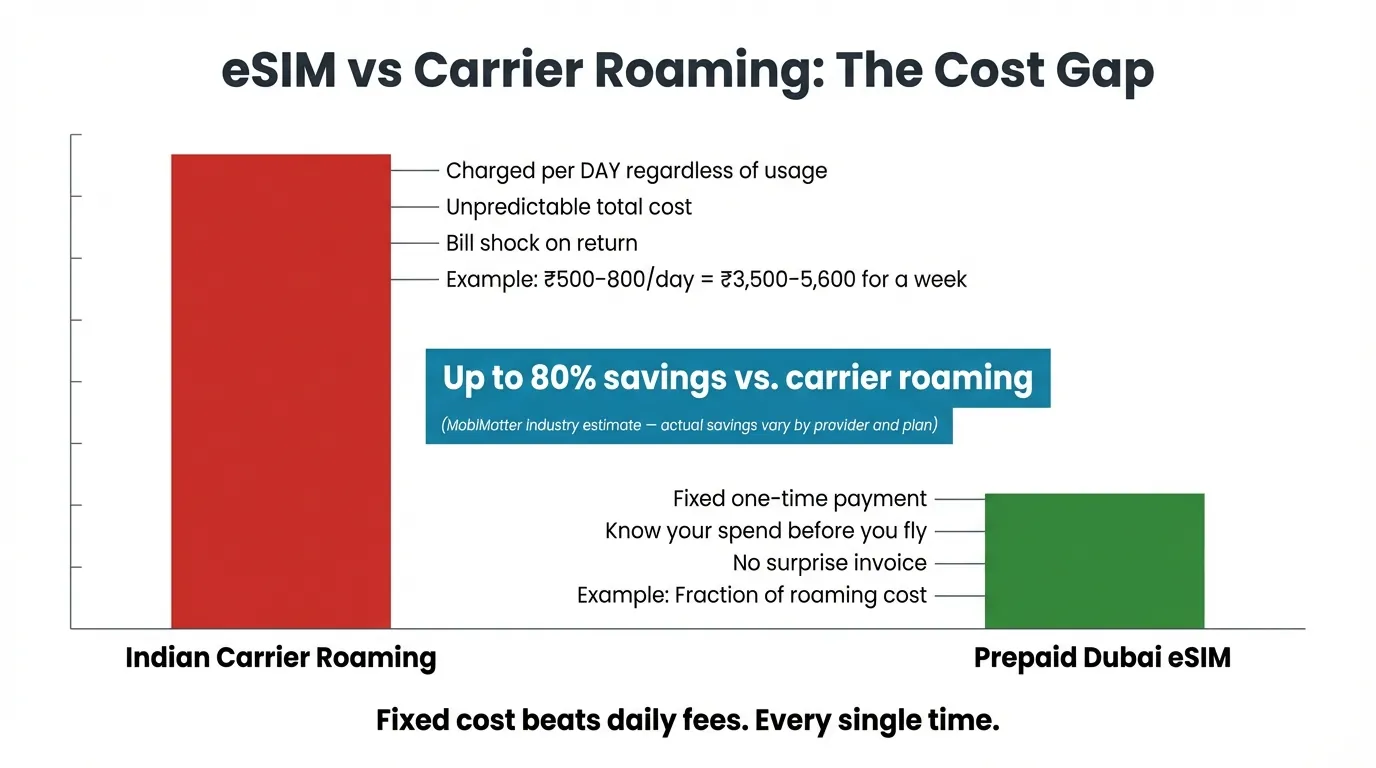
Carrier roaming is expensive, and the math isn't complicated. Your Indian carrier bills a flat per-day fee for international roaming whether you burn through 10MB or 10GB on a given day.
A prepaid Dubai eSIM turns that model on its head. You pay a fixed amount upfront for a set data allowance. No daily fees. No bill shock waiting for you at home. According to MobiMatter, industry estimates put eSIM savings at 70 to 80% on roaming charges compared to a home carrier's international plan. Treat that as a directional signal rather than a hard guarantee, because actual savings shift depending on which carrier you're comparing and which eSIM plan you pick. Still, the pattern holds consistently: prepaid eSIM beats carrier roaming on cost, almost without exception.
The savings are real.
Fixed-cost pricing also takes the anxiety out of the equation. You know your total spend before you even board the plane. No surprise invoice sitting in your inbox when you land back in India. That predictability carries genuine value, especially on longer trips where daily roaming fees stack up fast.
Pick a plan that matches your usage. Pay once. Travel freely.
How eSIMs Save Up to 80% Compared to Your Home Carrier's Roaming Plan
Carrier roaming fees tick up daily regardless of how much data you actually touch. A prepaid Dubai eSIM charges for a data allowance, not for time on the clock. MobiMatter's 70 to 80% savings figure is an industry estimate, and your outcome will vary by provider and plan. The structural gap is still obvious though: fixed cost versus variable daily fees. Fixed cost wins for budget control, every single time. Buy the plan before you fly, know your spend upfront, and skip the roaming bill entirely.
Prepaid data in Dubai is predictably cheaper. That's the point.
The Hidden Perks of Dubai eSIMs That Make Them Even Better Value
Some Dubai eSIM providers fold tourist discounts directly into their plans. Alike, for example, has offered deals including:
- 10% off a 30-day UAE Tourist Visa
- 20% off a Silver NOL Pass
- Direct discounts at 20+ popular attractions
Those are meaningful savings stacked on top of the connectivity cost reduction. Alike has also offered a complimentary 5G eSIM with 1GB data as a trial for new users. Worth flagging that all of these deals shift frequently. Confirm current availability directly with the provider before you book, because specifics change and what's live today may not exist when you travel.
Check verified traveler reviews to get a realistic picture of what other Indian travelers experienced with specific Dubai eSIM plans before committing.
The connectivity saving is consistent. The bonus perks are variable. Plan around the former and treat the latter as a welcome bonus if it happens to be available.
Conclusion
Five tips, one clear thread running through all of them: sort your connectivity before you leave India, not after you land in Dubai. The checklist is simple:
- Buy your eSIM before you fly
- Confirm your device is enabled and eSIM-capable
- Set up dual SIM so your Indian number stays active
- Size your data plan to your actual usage profile
- Skip carrier roaming entirely
Do all five before departure day.
For Indian travelers specifically, get your Dubai eSIM sorted before departure through Matrix, which delivers the QR code instantly by email with no airport queues and no roaming surprises. The process takes minutes, and the difference it makes on arrival day is significant. Dubai ranks among the most connected cities on the planet, and you should arrive ready to use that connectivity the moment you clear customs.
Sort the eSIM today. Don't leave it for the airport tomorrow.
