



Places to Visit in Vietnam: Ninh Binh, Where India's Buddha Relics Sit in Asia's Tallest Stupa
Two hours south of Hanoi, a province called Ninh Binh holds three things most Indian visitors to Vietnam never see. The country's first imperial capital, founded in 968. A 100-metre stupa, the tallest in Asia, whose top floor enshrines relics of the Buddha brought from India and whose walls were carved by Indian sculptors. And a river that runs straight through limestone mountains, so a rowing boat takes you into the dark of one cave and out into a hidden valley on the other side. The remarkable part: all three are within fifteen minutes of each other.
Most Indians go to Vietnam for Ha Long Bay, Hoi An's lanterns and the food. Ninh Binh sits on the road between Hanoi and everything else, and most tour buses drive straight past it.
This is what is there, why it matters, and how to see all of it in a day.

Vietnam's First Capital Was Here, Not Hanoi
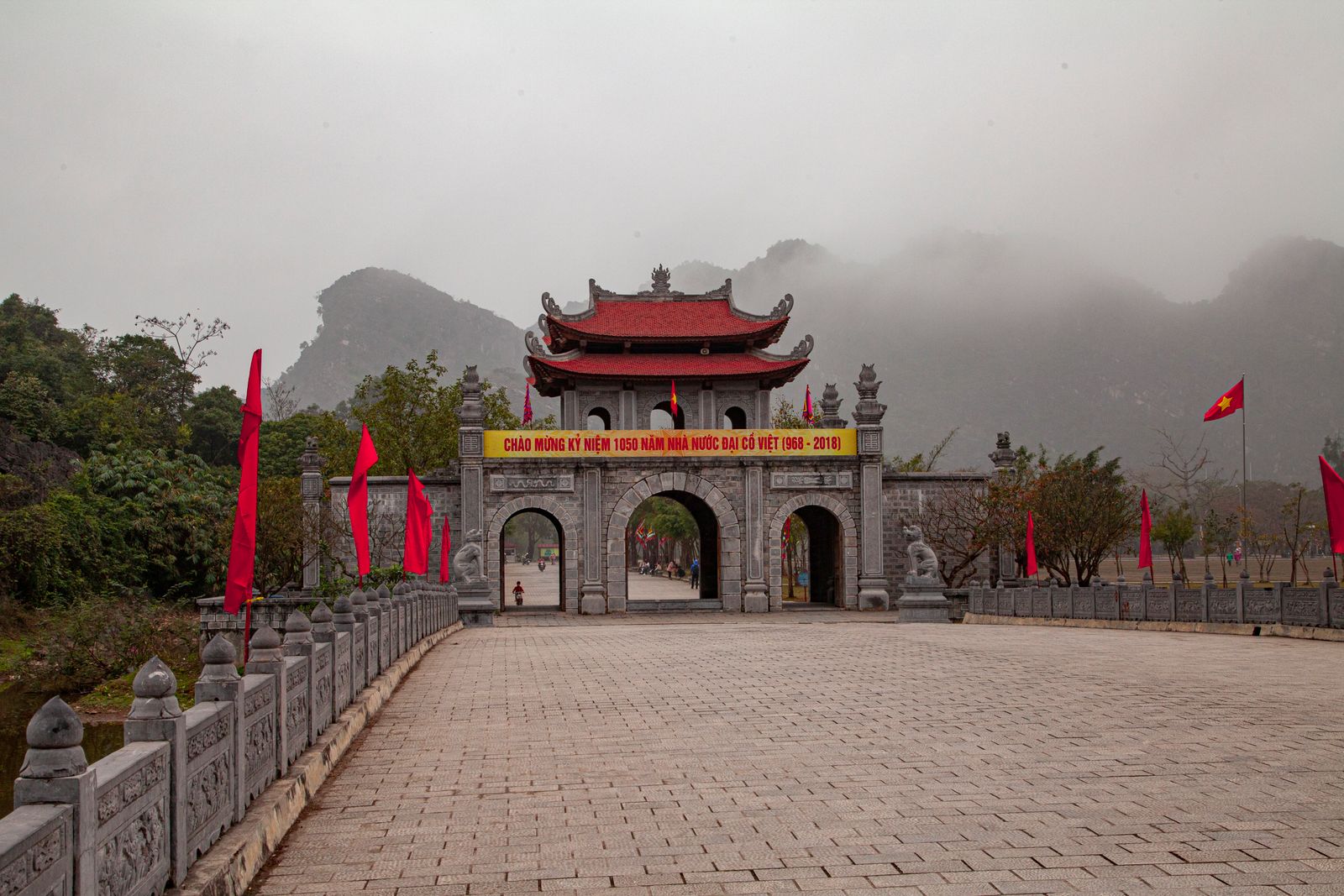
In 968, after decades of fighting between warlords, a general named Dinh Bo Linh unified the country, declared himself emperor and built his capital at Hoa Lu, a valley ringed by limestone cliffs that worked as natural fortress walls. Two dynasties ruled from here. In 1010, King Ly Thai To moved the court north to Thang Long, the city that became Hanoi, and Hoa Lu emptied.
What survives are two 17th-century temples to the Dinh and Le kings, built on the old palace foundations, and the cliffs themselves. It is a quiet site, and it explains why the region's biggest pagoda was built where it was: the monks who advised those first kings came from the mountain next door.
Bai Dinh: A 1,000-Year-Old Cave Temple and the Complex Built Around It
The original Bai Dinh pagoda is a shrine inside a mountain cave, founded under the Ly dynasty in the 11th century by the monk-physician Nguyen Minh Khong. It is still there, about 800 metres uphill from everything else, and it is the part most visitors skip.
Everything else was built between 2003 and 2010, and it was built to be the largest Buddhist complex in Southeast Asia. The scale is deliberate. A 100-tonne bronze Shakyamuni Buddha, recognised as Asia's largest gilt Buddha statue. A 36-tonne bronze bell. A corridor of 500 stone arhats, each carved with a different face, running for close to 3 km around the hillside. An 80-tonne bronze Maitreya on the highest hill.
The stupa, and what is on the 13th floor
On the western side of the complex stands Bao Thien Stupa: 13 storeys, about 100 metres tall, with a hexagonal brick base decorated in Ly-dynasty clouds, waves and lotus petals. There is a lift, and the 12th floor has a viewing gallery over the whole complex and the Trang An karsts beyond.
The 13th floor is the point of the building. The relics of Shakyamuni Buddha enshrined there were brought from India, Thailand and Myanmar, kept in eight small stupas arranged around a central one. The ceiling is designed in an Indian style around a central lotus, and hundreds of Indian sculptors worked alongside Vietnamese artisans to carve the reliefs of the Buddha's life that line the interior walls.
For an Indian visitor, that is the detail to hold on to: the tallest stupa in Asia was finished by craftsmen from India, and the most sacred thing inside it came from India too.
Trang An: A River That Runs Through the Mountains
Fifteen minutes from Bai Dinh, the road ends at a jetty. You step into a small metal boat with three other passengers and a rower, usually a woman from the local village, who will spend the next two and a half hours taking you along a river that does not go around the limestone peaks but through them.
The route threads a series of water caves, some 300 metres long, where you duck under the ceiling and the only sound is the oar. Each cave opens onto a closed valley of still water and cliffs that cannot be reached any other way. Small temples sit on the banks between them.
Trang An was listed by UNESCO in 2014 as Vietnam's first mixed natural-and-cultural World Heritage site, for the karst landscape and for the traces of people who lived in these caves as far back as 30,000 years. In 2016 it was the main location for Kong: Skull Island; the village set built for the film still stands on Route 2.

Which route to take
There are three routes from the same jetty. Route 1 is the longest, with nine caves and the most temples. Route 2 is the Kong route, with the film village and the largest cave. Route 3 is the quietest, with fewer stops. All three cost the same, and all three end back at the jetty.
Mua Cave: 500 Steps to the Photograph
Ten minutes from Trang An, Hang Mua is the viewpoint at the top of a limestone peak, reached by roughly 500 stone steps. The climb takes 20 to 30 minutes. From the dragon statue at the summit the whole Tam Coc valley lies below: rice paddies in squares, the Ngo Dong river winding between them, boats on the water, and karst towers in every direction to the horizon.
It is the most photographed view in northern Vietnam outside Ha Long Bay. From late May to early June the rice turns gold before harvest, which is when the photographs you have seen were taken. In June and July the lotus pond at the base is in flower.

How to Visit, from Hanoi
| Bai Dinh Pagoda | Trang An | Mua Cave | |
|---|---|---|---|
| Where | Gia Vien district, about 100 km from Hanoi, 15 km from Ninh Binh city | Hoa Lu district, 7 km from Ninh Binh city | Hoa Lu district, near Tam Coc |
| What it is | Southeast Asia's largest Buddhist complex, beside an 11th-century cave pagoda | UNESCO-listed karst landscape seen by rowing boat | Hilltop viewpoint over the Tam Coc valley |
| Getting there | Limousine bus from Hanoi's Old Quarter, 2 hours, around ₹500–700. Then Grab or a hired scooter | Grab or scooter from any Ninh Binh homestay | Bicycle or scooter from Tam Coc, 10 minutes |
| Entry | Free. Electric cart around 60,000 dong (₹220) return; stupa around 50,000 dong (₹180) | Around 250,000 dong, roughly ₹900, for the boat | Around 100,000 dong, roughly ₹350 |
| Hours | Typically 6am to 9pm | Typically 7am to 5pm; last boats around 4pm | Typically 6am to 7pm |
| Time needed | 2 to 3 hours | 2.5 to 3 hours on the water | 1 hour, more at sunset |
Prices and hours change, so confirm before you travel.
Getting to Ninh Binh
Hanoi is the gateway, and the seat cap on India–Vietnam flights was doubled in September 2026, so more direct services are likely. From Hanoi, the shared limousine buses pick up in the Old Quarter and drop at your homestay; the train from Hanoi station to Ninh Binh takes about 2.5 hours and costs around ₹400. Book the bus a day ahead in October and November.
Doing Ninh Binh properly
- Do it in this order: Bai Dinh at opening, Trang An after 1pm, Mua Cave for sunset. The morning crowd at Trang An clears by lunch and the afternoon light is better in the caves
- Walk up to the ancient cave pagoda at Bai Dinh. It is the reason the site exists and almost empty
- Take the lift to the stupa's 12th floor and walk the last flight to the relic chamber on the 13th
- Choose Route 1 at Trang An unless you specifically want the film set. Ask for a boat that leaves as soon as it fills, and tip the rower 50,000 dong at the end
- Wear real shoes for Mua Cave. The steps are uneven and slippery after rain
- Stay two nights in a Tam Coc homestay, ₹1,500–3,000 a night with bicycles included. The second day is for the Tam Coc boat ride, Bich Dong pagoda and Hoa Lu
- Carry water and cover shoulders and knees at Bai Dinh. It is a working pagoda
Why This Trip Lands Differently for Indian Travellers
At Bai Dinh the monks will ask where you are from, and the answer changes the conversation. To Vietnamese Buddhists India is the source, and when Sarnath's relics toured the country in May 2025 the queues stretched for kilometres. You will stand in a chamber whose relics and whose carvers came from home, and you will recognise the lotus, the mudras and the iconography without a signboard.
And then you get into a boat and go through a mountain. Nothing in the pilgrimage circuit at home prepares you for that part.
Vegetarian food is not a problem here. Bai Dinh has a large cơm chay dining hall, and every Tam Coc homestay will cook without meat, fish sauce, garlic or onion if you ask the night before.
Before You Go
- Grab thins out on the road to Bai Dinh and disappears inside the Trang An valley. Download offline maps for the whole province
- Screenshot your homestay's address in Vietnamese for the bus driver. Many homestays share a name with three others down the lane
- Dress for the pagoda. Shoulders and knees covered at Bai Dinh; robes are usually available at the gate
- Time your visit. October to April is dry and cool. The first lunar month brings the Bai Dinh festival and the biggest crowds of the year
One quirk of the Vietnam eSIM
The Matrix Vietnam eSIM must be bought no more than 10 days before your travel date, the opposite of the usual advice. Validity is 7, 15 or 30 days, and data pauses after 5 GB in a calendar day. From ₹999. Your Indian SIM stays in the phone for OTPs.
Browse Matrix Vietnam eSIM plans →
Read Next
- Places to Visit in Vietnam: The Hindu Temples Most Travellers Miss — My Son and Po Nagar, the other India connection
- India-Vietnam Aviation Agreement 2026: What the New Air Connectivity Means for Travellers
- Best Time to Visit Vietnam — the north is at its best from October to April
- Vietnam eSIM vs International Roaming
- All Matrix eSIM plans by destination
Frequently Asked Questions
Where is Ninh Binh and how far is it from Hanoi?
Ninh Binh province is about 100 km south of Hanoi. The limousine bus takes around two hours; the train about two and a half.
Are there Buddha relics from India in Vietnam?
Yes. The 13th floor of Bao Thien Stupa at Bai Dinh Pagoda enshrines relics of Shakyamuni Buddha brought from India, Thailand and Myanmar. The stupa's interior reliefs were carved by Indian sculptors working with Vietnamese artisans.
Is Bai Dinh Pagoda free to enter?
Entry to the complex is free. The electric cart from the gate and the stupa lift are paid, around ₹220 and ₹180 respectively. Confirm current prices before you go.
How much does the Trang An boat ride cost?
Around 250,000 dong, roughly ₹900, for a seat in a shared four-person boat. The ride lasts 2.5 to 3 hours. A tip for the rower is customary.
Can I do Bai Dinh, Trang An and Mua Cave in one day?
Yes. They are within 15 minutes of each other. Start at Bai Dinh when it opens, take the Trang An boat after lunch and climb Mua Cave for sunset.
What is the best time to visit Ninh Binh?
October to April for cool, dry weather. Late May to early June for golden rice fields in the Tam Coc valley. Avoid the first lunar month unless you want the Bai Dinh festival crowds.
Is Ninh Binh suitable for vegetarian travellers?
Yes. Bai Dinh has a large Buddhist vegetarian dining hall, and homestays will cook vegetarian, and Jain-style without garlic and onion, if told in advance.
Was Kong: Skull Island filmed in Ninh Binh?
Yes. Trang An was the film's main Vietnamese location in 2016, and the village set built for it still stands on boat Route 2.
